

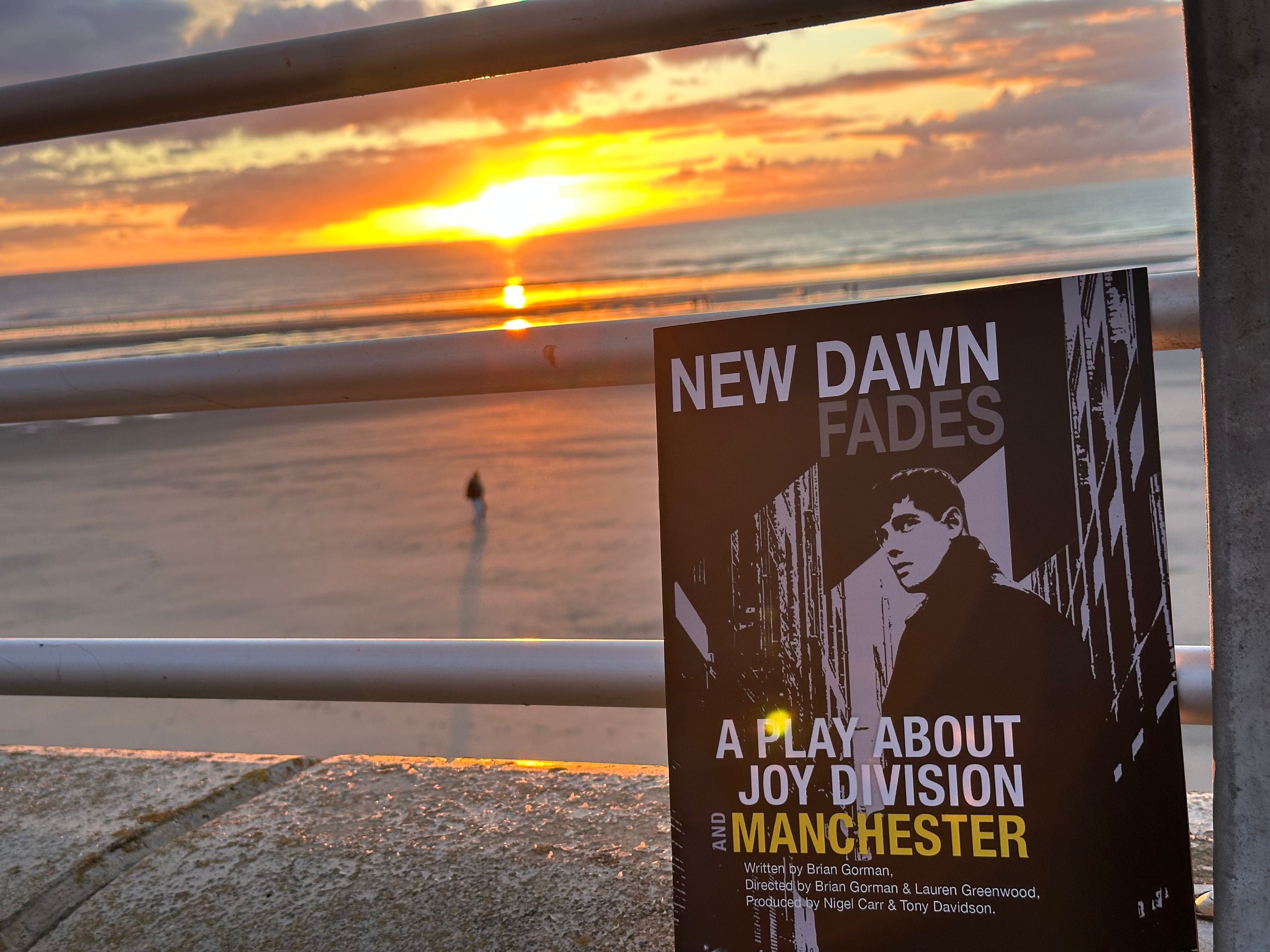
New Dawn Fades at Blackpool Grand Theatre — 22 October 2025
By Peter Shukie
New Dawn Fades returns to a familiar history but this version restores the uncertainty that built it. The production shows the moment before myth, when Joy Division were four young men in a rough city trying to make something from the ground up. Brian Gorman plays Anthony H Wilson as the voice holding the city’s multiple histories together. Romans, Engels, Pete Shelley, even Dr John Dee appear on stage. Engels is there not as saviour but as someone who looked at working class life and wrote about conditions he did not fully share. These figures remind us that stories fold into each other across centuries, not through official channels but through strange and risky experiments, like the scorch mark on a table in Chetham’s Library that legend says was left by the devil dancing in one of Dee’s summoning attempts. Knowledge has always found other rooms.
Josh Lonsdale plays Ian Curtis with a Romantic sensibility that does not drift into fantasy. He is a young man trying to balance work, home, epileptic episodes and a creative mind racing ahead of everything around him. The Jobcentre counter where he worked appears briefly but meaningfully. It was not a side detail in his life. It was the system he was part of and trapped within, helping people while knowing that survival was fragile for everyone there. His performance keeps that contradiction visible. It was impressive to see that complexity handled without sentimentality.
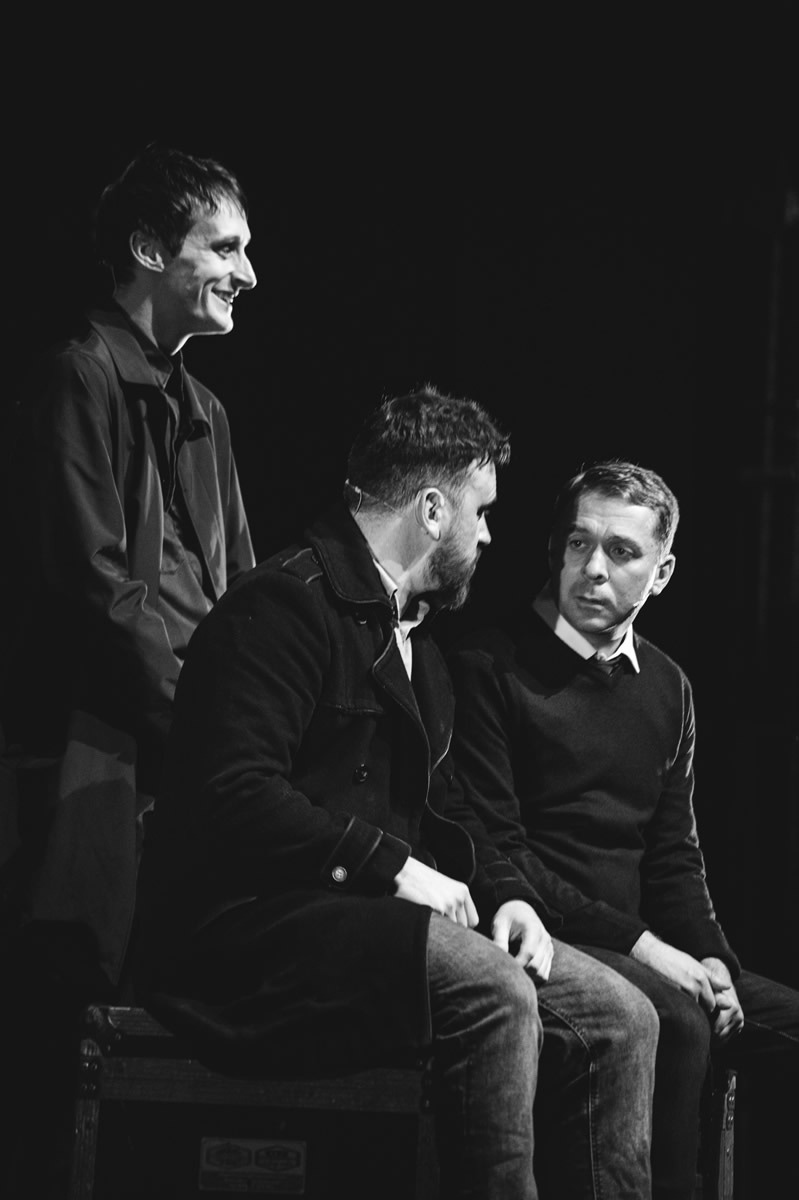
Gaz Hayden gives Peter Hook a strong presence with humour and that blunt edge that survives in people who have had to get on with things. Nicholas Eccles and Kivan Dene take on many characters and keep the pace up, pulling us through time without losing the thread. The history of Manchester might seem too big to fit into one story but here it feels like a reminder that creativity is not new in the city. It grows in cracks and corners despite everything.
The play shines when it shows how Joy Division started. Not from opportunity or invitation but because spaces existed where music could break out. TJ Tony Davidson ran TJM Studios in a battered mill. Cold, cheap, no glamour. Essential. Davidson was there in Blackpool. He and Nigel Carr gave me a programme and spoke like they were pleased I had made the journey. It was only later, sitting in Wetherspoons on the promenade with that programme in front of me, that I realised the scale of what they had done. They helped something happen that none of us can now imagine the world without. They did it because it needed doing.
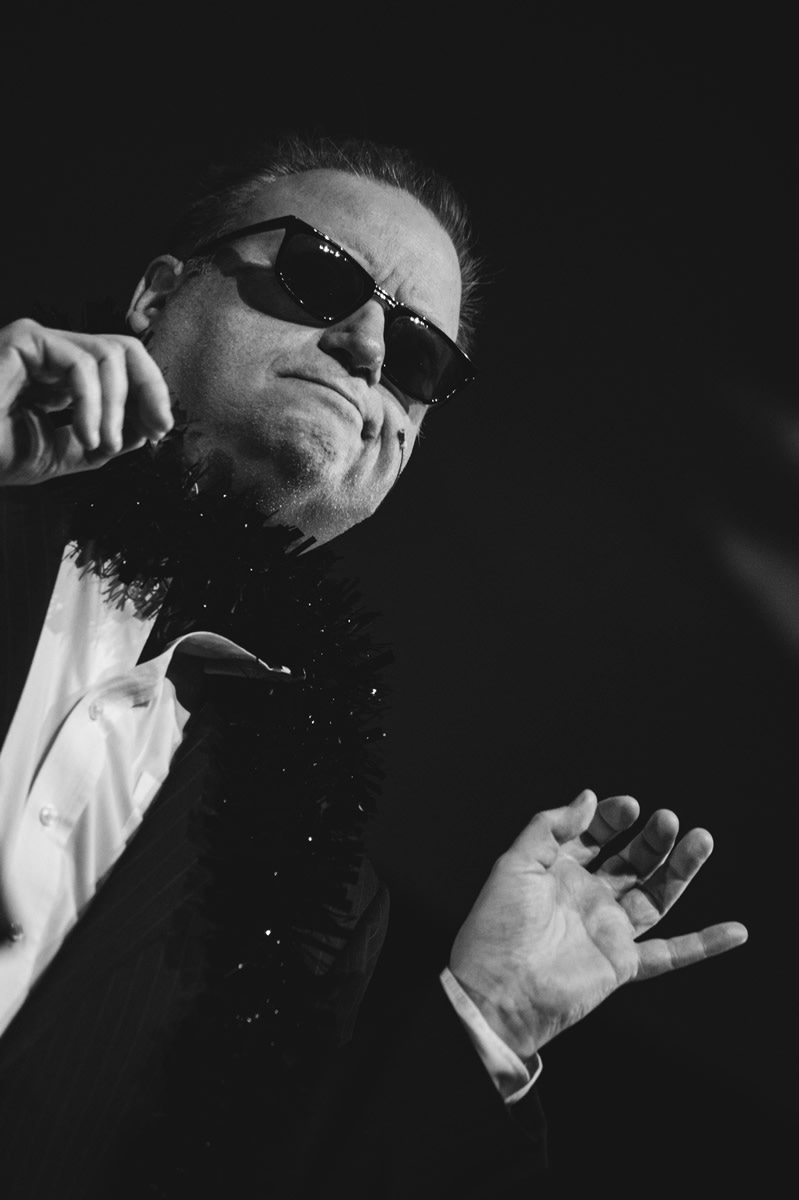
The show captures Manchester truthfully when Davidson tells the band that the building once stabled the Yeomanry horses sent to crush protesters at the Peterloo Massacre in 1819. That history is not distant. Oppression remains near the rehearsal room door. The play does not soften this. Wilson asks Hook what Manchester was like in the 1960s and 1970s and Hook replies, it is a shithole. It was not a romantic past but the need to create something out of nothing.
Nostalgia shows up but with thought behind it. A PG Tips Tea, Mr Shifter advert flashes up and the audience laughs together. It is a moment we recognise but it is not the usual sentimental image of the old days. It cannot be remade now, and that is for the best. We can remember without wanting to return to those conditions. The memory of a thing is not the same as the celebration of it. These were different times, and the pressures that bore down then are not what clatter around us now. Still, the need for visibility remains. Still we need signs that poets exist in our spaces and can thrive. It was these small moments scattered throughout the performance that added the spice that burned a little. Shots of familiarity and distance; stabs of memory and movement created by these people in these places and we keep them with us now.
The pulsar image appears on the big screen, the Peter Saville cover for Unknown Pleasures. Curtis is asked, what the fuck is it, and he replies, a pulsar. A tiny ten kilometre remnant of a dead star still sending out a signal across unimaginable distance. The play gives us a photograph of Curtis looking at that image, and the script lets him name it. The science matters. The power of something that no longer exists in the same way. Energy condensed and still visible, just about. It is a perfect symbol for the city, for the band, for all that orbited them in that time and space, and for the production itself. All this pressure, all this energy, squeezed into small rooms and still visible decades later. The show does not present the cleaned up version of what they became. It shows the time as it was. The shocks, the uncertainty, the awkwardness. We have the comfort of hindsight. They did not. That difference matters.
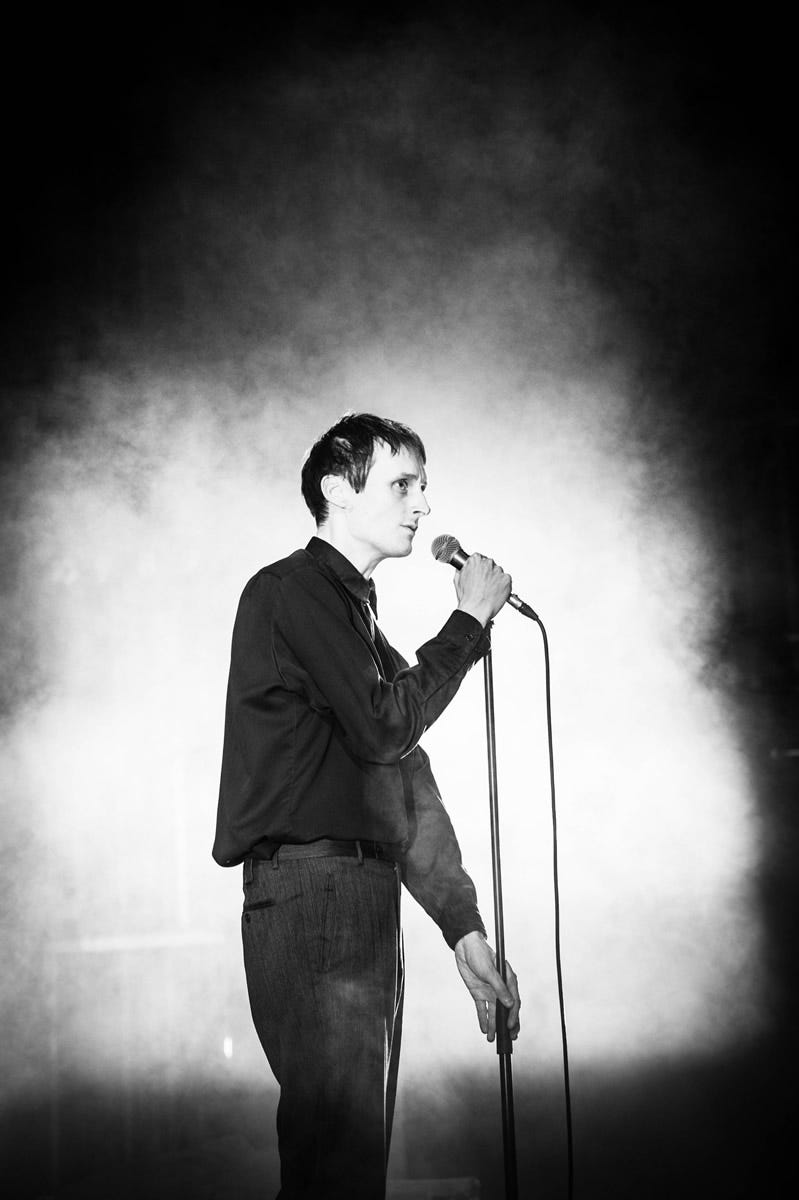
Curtis carried a different kind of responsibility from the Romantic poets we learned in school. Percy Bysshe Shelley could write about revolution with inherited safety behind him. Curtis was working in the Employment Exchange, surrounded by the disabled and the unemployed, feeling the pressure not to let anyone down. A new baby, a mortgage, care responsibilities. When he sees Davidson’s Lotus Esprit outside TJM Studios, he feels the distance between the life he has and the one he is trying to make. The tension was never candlelight. It was survival.
Then Pete Shelley appears. Pete Shelley from Leigh, not Eton. A musician Curtis could meet in real rooms. Curtis notes that he was not like a superstar at all. That matters. It shows how close talent can be, how possibility comes not from far off idols but from someone a few miles up the road. A Shelley who took his name from a poet but made his own version of the role. It reminds us that the Romantic impulse does not belong to privilege. It lives in people who feel more than they can contain and still show up to work the next day. Engels once walked these streets and wrote about what he saw. Wilson crossed into Cambridge and back, a bridge figure between exclusion and access. Curtis remained inside the struggle. He was not observing class conditions. He was living them.
The Alternative Curriculum
Where that pulsar emanates, and how it came to be on a record sleeve, is about curiosity and the routes we make when the official ones are closed. The most important part of the production for me is the reminder that self generated culture can be a better education. Tessa Norton writes about Mark E Smith creating an alternative curriculum. I understand this. In school, culture came through old books read by bored teachers. Stories flattened, dialects removed, interpretations fixed and tested. Our real learning came later and elsewhere.
It was in libraries and record shops and the writing found in random places and small publications. In late night films on tiny televisions. We found Kafka before any teacher mentioned him, pulled in by references in songs and interviews. I read French philosophy in Wigan Library between trips to the Jobcentre, trying to stretch my world beyond what was offered. Curtis once met William Burroughs and was told, fuck off kid. We were never the intended inheritors of that literature. Yet maybe we were always the natural inheritors of the surreal and the survivor. You do not need to know the perpetrators, of either the ugly machine or the soft machine, you just need to be alive to your own worth.
Joy Division took their name from House of Dolls, a novel that fictionalises some of the worst horrors imaginable. It was not a joke or an aesthetic. It was an attempt by post war youth to process a world filled with trauma. They were children of a victory that still looked like ruins. Industry was collapsing. Futures were collapsing with it. They used the fragments available to build something else. These stories never leave us, but they need to be told and retold. They were also part of a generation still living with the debris of war. The fascist links sometimes projected onto Joy Division from today flatten the complexity of where they came from. The name’s roots in House of Dolls were not celebration but confrontation. The play acknowledges that they were trying to understand a world that still felt wounded.
There is a magic of misery that sometimes clumsily defines us as northern and working class. A Taste of Honey, and the first BBC Two films where we heard our own voices and saw our streets. Rita Tushingham, Delaney’s Charlie Bubbles from 1968, British New Wave cinema showing northern lives without decoration. Not always taught. Not always stored. We mined them because we needed to see someone like us with a voice. These were teachers, whether they knew it or not. New Dawn Fades makes those influences visible again. Romance, yes, but the kind forged under strip lights and concrete skies.
The Place Itself
Blackpool Grand Theatre is exactly where this play should be. The ceiling is decorated with the faces of the accepted culture, Shakespeare and Hamlet among them. The building spent years as a bingo hall and almost disappeared when developers tried to take it down in the 1970s. It came back as a theatre in 1981, months after Curtis died. I saw Boys from the Blackstuff here earlier this year. These walls have held decades of working class stories. Not tidy ones.
Outside after the play, I walked past children in neon unicorn horn hats, candyfloss, the sea in darkness. The illuminations throbbing along an autumn night, Blackpool generating its own feral beauty from old habits. That has always been the way. The audience leaving the theatre were excited, not just remembering but recognising themselves as part of the world created. The past is not there to be mourned. It is there to be used. I know Blackpool’s reputation, and I have no idea if Ian Curtis ever came here. It does not matter. The play reminds us he was the essential combination of working class poet and visionary that this town fosters too. Brilliance couched in humility and acceptance, creative work in a world that easily crushes the poor. The struggle is the thing. The trick is to create despite it.
Class, Access and What Comes Next
Only a small percentage of the UK’s paid creative workers are now working class. Tokenism exists. Appropriation exists. Our culture is used to brand cities that quickly shut out the creators who made it possible. Institutions talk about access while raising ticket prices. Unwaged tickets at the new Aviva and Factory International can be close to a week of Universal Credit. Accents still mark where you belong. The play shows the difference between an RCA executive looking for safe bets and those who worked in damp mills to make something new. The chances of encountering a wandering Shelley now often seem as distant as that flickering pulsar. They are around, in the polished glass and steel of the city, but not as often in the streets beyond the new Gotham.
In the play, Wilson calls some of the people around the early scene civilised gangsters. That is part of the truth. Clubs were thrown together. Studios were damp. Access often came with conditions and with characters who walked a line between helping and hustling. But those doors were open, even if only slightly, and it was enough to get things started. It was messy, but it worked and it made art possible.
The tension is still here. Do we have rooms now where someone like Joy Division could rehearse without permission from a board or a sponsor. The energy is not enough if there is nowhere to plug it in. The yeomanry at Peterloo did not arrive by accident. Suppression is never accidental. Gatekeeping is never neutral. Creativity needs space and time. Not charity or guiding hands. Just space to try. There is no Manchester culture without working class people. The rest is packaging.
Why Tell It Again
This production is not a guidebook for success. It is not asking us to repeat anything. It shows that small acts matter and grow beyond expectation. That the joy and the tragedy of working class art is how fragile and powerful it can be at the same time. We are reminded that the poets and musicians and dreamers were not distant figures. They walked the same streets. Sat at bus stops in the cold. Worried about wages and rent and care. They made something anyway. Many paid the price for it. We tell this story again because we need to. Because we deserve to know that creativity does not only come from the places that claim to teach it. Because our perspective matters. Because these are not old tales but part of who we are now.
The pulsar still sends out its signal and we can still see it if we look, we can still respond. The task, as Joy Division and later New Order both did, as Brian Gorman has with this play, is to build something from the scraps we are handed and the rooms we find. This play shows what has been possible. The task now is to create the conditions for what comes next. Not through invitation, but through our insistence that we belong in the story.
Peter Shukie
Best thing you've written. Seriously, it has stuck deeply in my bones, my head, my soul.